

The Politics of Technology: Three Key Takeaways
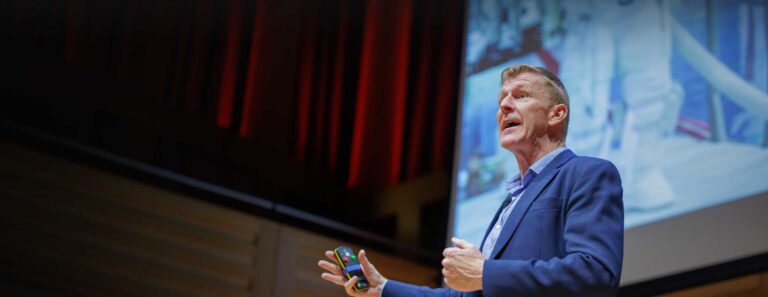
JLA had the pleasure of welcoming three of the most compelling voices sitting at the intersection between technology and global affairs to the stage at One Moorgate Place.
We heard from Matt Clifford, entrepreneur, investor, and former AI adviser to two British Prime Ministers, and Sarah Wynn-Williams, global public policy expert and author of the bestselling Careless People. The pair were joined in conversation by Gordon Corera, former BBC Security Analyst and co-host of The Rest is Classified.
After 25 years covering national security, Gordon opened the session with an unambiguous verdict: the world really is more unpredictable than it has ever been. However, he was careful to stress that it is not necessarily more dangerous.
What defines the present moment is a particular kind of uncertainty, driven not just by the familiar disruptions of geopolitical rivalry and conflict, but by the accelerating role of technology. AI, Gordon argued, is both a driver of that disruption and a casualty of it – it fuels the race between the US and China, and is simultaneously shaped by the pressures that race creates.
The consequences of this tension are no longer abstract. The question of who controls the most powerful AI systems is fast becoming one of the defining questions of our age. No business leader can afford to ignore it any longer.
Wednesday’s conversation dissected the technological and political forces reshaping our world – from AI’s exponential advance, to the geopolitical chess-match between the US, China, and the rest of the globe. We’ve distilled three of the most resonant takeaways from the morning.
1) AI’s Trajectory Matters More Than Its Current State
Matt opened his remarks by attempting something ambitious: resolving one of the great paradoxes of the AI debate.
Open any newspaper and you’ll find two entirely contradictory narratives living side by side. ‘AI is driven by hype, and it’s about to crash’ dominates one side of the conversation, and ‘AI’s going to take everyone’s jobs and consume the entire economy’ grips the other. Both cannot be true simultaneously. Or if they can, we need to open up more nuance.
To tackle this problem, Matt redirected attention to the extended history of modern AI. Rather than beginning with the advent of ChatGPT in 2022, he highlighted that it actually kicked off much earlier, with many thought-leading papers released as far back as the early 2010s. Matt explained that decades-old AI ideas are now finally able to become actualised – not because the ideas themselves have changed, but because computational power has finally caught up. We have been on a continuous, exponential curve ever since.
"The most important measurement to watch when following AI’s growth and development is simple. How much work can you outsource to an AI? "
The answer has moved from two to four minutes in 2023, to twenty minutes in 2024, to two hours in 2025, and roughly ten hours in 2026. With a doubling period of approximately six months, Matt’s political takeaway was clear: a world where you can delegate a working month of work to an AI is a world transformed. Whatever this ultimately means, we must remember that there are still six more doublings to go before the next general election hits.
Matt also aimed to dismantle a big mistake when thinking about AI: that its development is aimed at bringing it closer and closer to the human mind. This, he asserts, is a “category error”.
The skillset of AI is vastly different in scale and nature to that of a human being. For this reason, he believes that the threat of AI replacing jobs shouldn’t be overestimated – there are no AI-shaped holes in the world we live in, but there will always be human-shaped ones. Its integration into day-to-day business relies on redesigning our workflows, and understanding how we can best take advantage of it.
2) Paying Attention to Global AI Developments is Critical
Sarah shifted focus to the global implications of AI’s impact. With much of the attention, debate, and oxygen around AI focused on a handful of companies in the United States, she argued that its development in China is going largely unexamined. Whilst there’s certainly geopolitical contention, the competition around models is also important to keep track of.
A fundamental strategic divergence between these two superpowers sits at the centre of this rivalry. The US is betting on closed models – proprietary systems developed and controlled by companies like Anthropic and OpenAI. On the other hand, China has bet on open source, exploring this with DeepSeek, Qwen and other companies.
Open models offer accessibility and adaptability; closed models tend to offer greater refinement, and clearer lines of accountability. The question of which approach wins is far from settled, and the answer will shape the landscape that businesses are operating in for years to come.
Crucially, China’s models are also free to use, and are built to remain so. With only around 5% of users currently paying for Western AI tools like Claude or ChatGPT around the world, the shape of the competitive threat comes into focus.
In a prolonged cost-of-living crisis, as the UK is facing, price is far from trivial as a factor. For businesses evaluating which AI tools to adopt, and for those thinking about where their customers and partners around the world are making the same decisions, the economics of free versus paid deserve serious attention.
Which AI platform a business or a country chooses to build on top of is not simply a procurement decision. It is a decision about whose infrastructure, whose values, and whose information sits at the heart of your operations.
3) The Case For Optimism In The UK
Where does the UK sit in all of this? Do we have enough agency to carve a name for ourselves in the AI space, or are we trapped in a tough spot between two giants?
Sarah was quick to emphasise the short-sightedness of Silicon Valley, with all decisions made from a heavily US-oriented perspective. With this in mind, it’s difficult to avoid concluding that the UK risks slipping by the wayside, largely cut out of the picture.
And yet, Matt made a considered case for cautious optimism, built on three pillars.
- Firstly, the UK’s AI ecosystem is genuinely world-class.
- Secondly, the UK’s state capacity in understanding the security implications of AI is arguably unparalleled outside the US and China.
- Thirdly, in a moment of growing tension between the US and its traditional allies, middle powers with the ability to convene, build coalitions, and earn trust across divides have a real opportunity to shape the rules of the road.
The UK’s position, both agreed, is precarious. But precarious is not the same as powerless. The quality of engagement in rooms like One Moorgate Place, as we saw last week, stands as a reason for measured hope.
If you missed us at this Speaker Breakfast, highlight of the session will be available here once edited. To enquire about Matt, Sarah, or Gordon speaking at your own event, please contact us today.
We look forward to seeing you at our next JLA event!