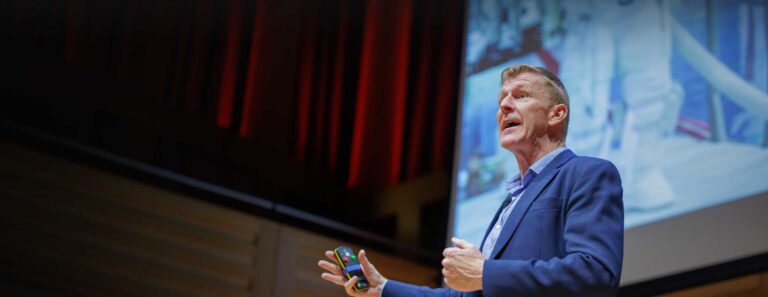

Dex Hunter-Torricke
AI & Public Policy Expert, Formerly Google, Meta & SpaceX
Author, Empire of AI & Co-host, The Interface Podcast
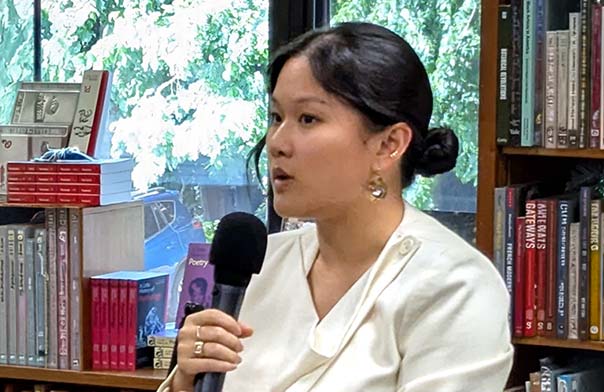
Award-winning journalist and author Karen Hao was one of the first to explore the workings of Silicon Valley's leading AI companies. In her acclaimed international bestseller Empire of AI , she addresses the conflict between the claim AI ca
Karen Hao is an award-winning journalist and author, and was previously an engineer at a Silicon Valley startup. She writes extensively on AI, covering developments in the industry and advances in the technology's capabilities, and what these mean for society. After covering American and Chinese tech companies for The Wall Street Journal, she now covers AI for for publications including The Atlantic, and leads the Pulitzer Center's AI Spotlight Series, training journalists around the world on how to cover artificial intelligence.
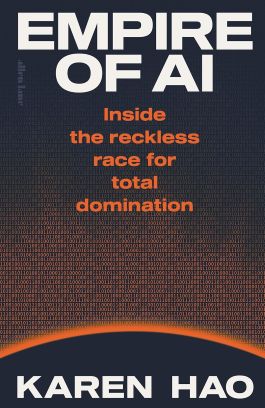
Karen is the author of Empire of AI: Dreams and Nightmares in Sam Altman's OpenAI. The book was a New York Times bestseller immediately on release and has gone on to win awards and acclaim around the world. The first journalist to profile OpenAI, she was initially positive about the company's aims, structure and leaders, but hype, billions of dollars, and a lack of accountability has changed her perspective. From Karen's reporting cross five continents, speaking to everyone from Silicon Valley engineers to Kenyan data labourers to Chilean water activists, Empire of AI examines how a handful of global, rapid-growth companies are consolidating unprecedented power and wealth and reshaping the world. Empire of AI was named a best book of the year by The New York Times, The Economist and the Financial Times, and won the National Book Critics Circle Award for Nonfiction.
Alongside her writing, Karen is the co-host of the BBC's technology podcast, The Interface, exploring how technology is shaping our future. Named on the TIME100 AI and Business Insider's AI Power List as one of the most influential people in AI, Karen was described by TIME as 'fundamentally shaping many people's perceptions and understanding of the company at the centre of the AI revolution.' She asks whether AI will ever produce the broad and long-promised economic benefits, or whether the current path of development threatens to irrevocably damage democracy and consolidate power in the hands of a few companies. She addresses how Silicon Valley has popularised a narrative about AI being the key to progress, whilst events behind the scenes tell a different story. Using her research into the unprecedented resources required by the sector, she also looks at the enormous costs of AI development, from computing power and data processing to low-paid data labour and spikes in energy and water usage. She draw parallels between the behaviours, politics and competition of big AI and that of the state empires of the past. Whilst alerting the world to the perils of AI, Karen also considers where there are reasons for hope and what role we can all play in shaping AI so that it benefits everyone.
Before her work at The Wall Street Journal, Karen was a senior editor for AI at MIT Technology Review. Her work has been cited by Congress, featured in university curriculums and remade into museum exhibits. She has won accolades including an American Humanist Media Award and a National Magazine Award for Journalists Under 30. She sits on the AI advisory board of the Craig Newmark Graduate School of Journalism at CUNY. Prior to journalism, she was an application engineer at the first startup to spin out of GoogleX, and received a degree in mechanical engineering from MIT.
"*" indicates required fields