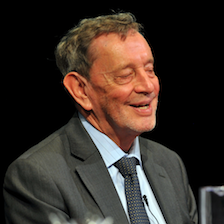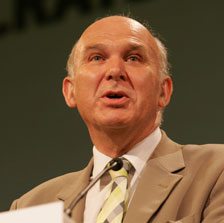

Michael controlled public spending as Chief Treasury Secretary, then led both Employment and Defence. He’s now an accomplished broadcaster. As well as cosying up to the opposition on the late night TV sofa, Michael has travelled America’s railroads. The ex-Conservative Cabinet Minister also weighs in on the debate in radio’s Moral Maze. After dinner Michael confesses that he often has problems with today’s politicians.
View / Submit“Michael hit the spot with our very diverse partner base.”
Allen & Overy
The former MP and cabinet minister Michael Portillo is now firmly established as a popular broadcaster and political commentator. Alongside television series on Spain, rail travel around Britain and Europe, and the natural world, he shares the sofa for a sardonic look at politics on This Week and weighs up ethical dilemmas on Radio 4’s The Moral Maze.
Michael began his career in the Conservative Party research department, developing policies for reducing the role of the state. He then became an advisor to the Secretary of State for Energy, working on privatisation schemes in oil, gas, electricity and coal.
Winning a parliamentary seat in the 1984 General Election, Michael was soon appointed a Government Whip and then Under-Secretary at the Department of Health & Social Security. In turn he was promoted to Minister of State for Transport then Local Government, where he oversaw the abolition of the poll tax. He entered Cabinet as Chief Secretary to the Treasury, controlling public spending and managing departmental allocations. He became Employment Secretary two years later, and finally took over at Defence. In total he served for thirty years in national politics with over a decade as a minister in the Thatcher and Major governments.
After leaving Westminster, Michael reinvented himself as a broadcaster and is a regular on TV and radio. He is perhaps best known for his five series of Great British Railway Journeys and two series of Great Continental Railway Journeys on BBC 2, exploring social and industrial history as he travels.
Often considered the greatest leader the Conservative Party never had, Michael talks about the problem with politicians and the humbling effect of his famed rejection by the voters of Enfield and Southgate.
Michael's charming, self-deprecating and always delivers the right blend of banter and content: it’s obvious he’s enjoying not being a politician. That said, he brings an enormous amount of heavyweight experience to bear – whether he’s facilitating a business debate, mapping out the geopolitical landscape at a conference, handing out industry awards or entertaining guests after dinner.
JLA Agent Anke Schuster