
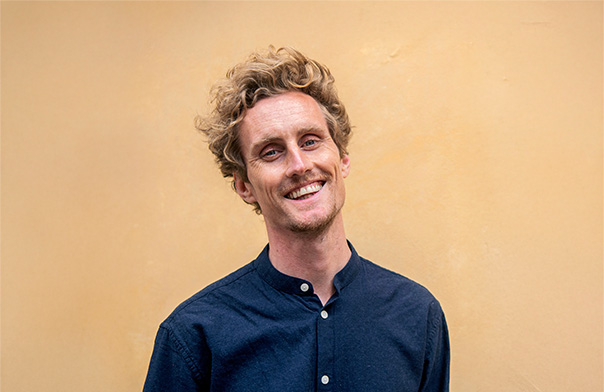
Ronan Harrington
Resilience Expert
There is a tension at the heart of every brief I get as a keynote speaker. Each company has an ambitious growth agenda to succeed in tough market conditions and they need their people to level up their performance to deliver.
The problem is that their staff are often overwhelmed by change fatigue, and are breathless from reaching the last financial milestone. The most recent Gallup State of the Global Workforce Report has revealed that 80% of the workforce are somewhat, often or always burnt out. This means a majority of employees are less capable of going the extra mile. How do we square that circle?
A keynote speaker can give that added burst of motivation and insight to continue the climb but it will falter if it’s founded on an outdated model of performance.
For the past 5 years, in collaboration with industry leaders like PwC, Deloitte, EY, and KPMG, I’ve been refining a new model of Sustainable High Performance. It’s a fundamental shift from endurance to resilience, driving higher levels of productivity and deeper levels of well-being.
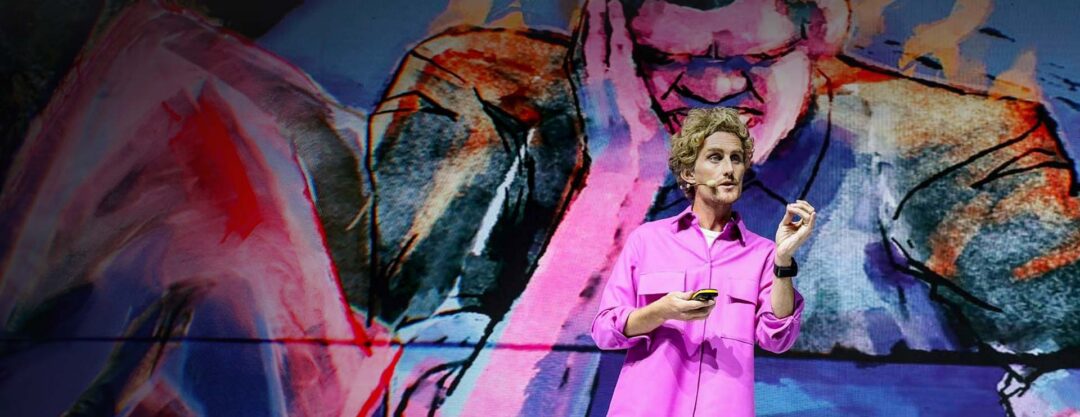
Keynote from the Salon Owners Summit

Every industry leader I work with has the same problem: excessive workload. This is a level of workload where you are consistently at the very edge or over of your capacity just to get through your day and week.
Addictive, social mobile technology is now the interface through which we face excessive workload, so we live in a boundaryless knowledge work environment. Our modern assembly line is the constant stream of tasks, requests and updates that come from email, MS teams, Slack, and WhatsApp.
There’s little we can do to stem the tide of excessive workload. If you’re on an ambitious growth trajectory, there will inevitably be a mountain of tasks to do, back to back meetings, and multiple deliverables to juggle.
When excessive workload is paired with addictive social mobile technology it gives rise to a subtle but all pervasive work culture built on the antiquated notion of Endurance.
This is where, faced with a digital avalanche of requests, we reactively push through, we plough on, we white knuckle it, even as we go beyond our capacity.
This is not just bad for our health, it gives rise to a screwed version of productivity that I call mowing the lawn. ‘If I get through my mountain of to dos, if I keep that grass nicely trimmed before it turns into a wild garden, I’ll quell my anxiety and feel confident I’m advancing my team’s work.’ We resort to a type of productivity that is about grinding out tasks, which has its merits, but when you think about the decisions or initiatives that have actually been game changers, they come from creating space to not just meet, but exceed expectations.
There is a naive hope that someday we’ll conquer our to do lists but as productivity thinkers from Oliver Burkeman to Cal Newport have vividly illustrated, you can never escape the never ending to do list. Each time you respond to an email you generate the potential for another reply! We cannot endure our way through a knowledge work environment that will deplete us by design. It’s a losing game.
The new model of sustainable high performance is built on resilience. Resilience says: ‘I notice I’m going beyond my capacity, I need to stop and rest, I need a smarter system to better manage my workflow and execute on my priorities; I need to be mindful when I feel the addictive compulsion to keep on working even when I’m not being optimally effective; and in my downtime, I need do the right practices that can keep my physical and mental buffer strong so I can take on greater pressure.’
To operationalise this we need to approach our working days, weeks, months, and indeed lives, as a deliberate cadence of peak exertion and renewal, peak exertion and renewal, peak exertion and renewal. We go beyond boom and bust cycles of legacy corporate endurance culture.
Paradoxically, optimal performance knows its limits, it pulls back from the danger zone. Think about a body builder that bench presses until they feel the burn. That’s their muscle fibres tearing so they regrow bigger. If they are in endurance mode and keep pushing, they don’t get to come back to the gym in three days, they have to sit it out for two weeks.
Sustainable High Performance is generally about staying inside the peak of your capacity, and then learning how to put into practice resilience protocols that expand your capacity over time so you can take on greater challenges.
Nick Petrie, a leading qualitative researcher on burnout, reveals that high performers with a low risk of burnout have intentionally shifted their work patterns to oscillate between pairs of polar opposites. This structured movement creates a dynamic work environment where intensity is balanced with rest, and focus is interspersed with broader collaboration.
The approach can be broken down into several key contrasts:
What makes this approach so effective is its intentionality.
These high performers aren’t in a constant state of hyper-focus or continuous multitasking. Instead, they bounce between these polar states, crafting a workday that helps them perform at their best and stay energised. This isn’t an accidental habit—it’s a well-practiced method that has been deliberately integrated into their daily routines.
For anyone looking to elevate their work performance while also safeguarding against burnout, the strategy is clear: embrace the power of oscillation.
Resilience Expert
Ronan Harrington is a conference speaker that advises industry leaders like Deloitte, PwC, EY, and KPMG on how to create high performance teams. His keynotes introduce a resilience-based approach to peak performance without compromising wellbeing, drawing on his experience as a Lead Futurist for the British Foreign Office. Having faced severe burnout and chronic illness, he highlights the need for organisations to tackle burnout as a public health issue rather than a personal failing.
To enquire about Ronan speaking at your next event or to get advice tailored to your specific event needs, don’t hesitate to get in touch with us!
